
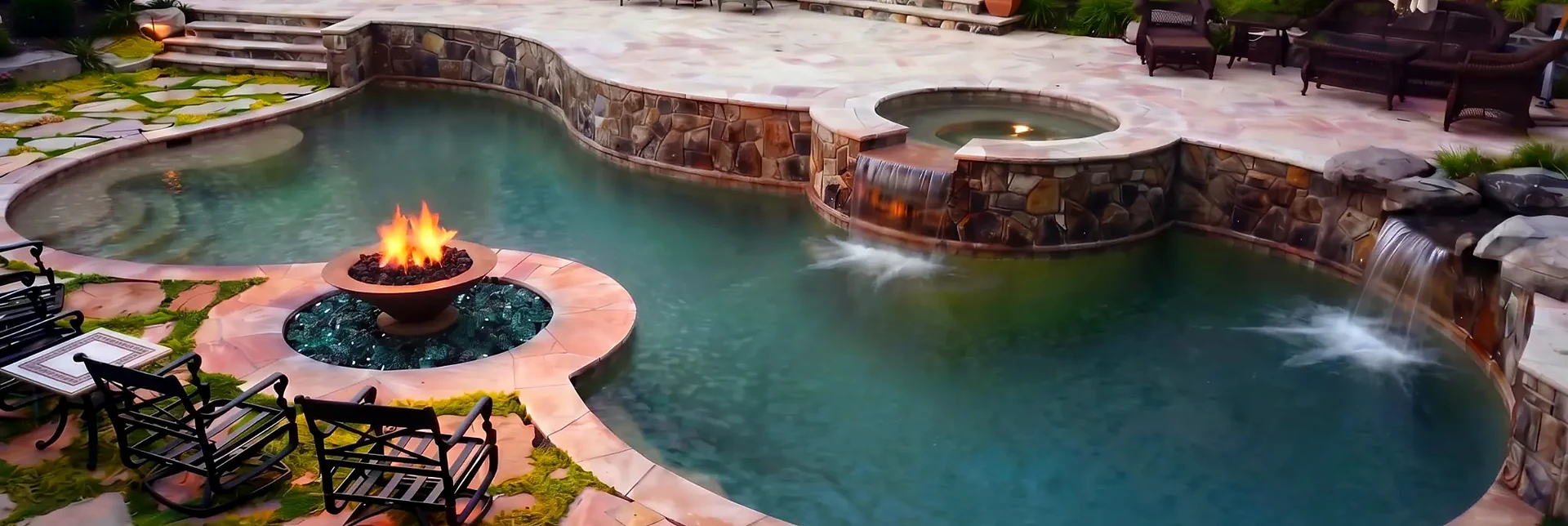
Choosing pool coping is one of the most consequential aesthetic and functional decisions when planning a custom gunite pool in southeastern Pennsylvania and western New Jersey. Coping forms the visible edge where deck meets pool wall, affects safety and comfort at the pool edge, controls water runoff and drainage, and influences long-term maintenance and lifecycle cost. For homeowners balancing design, budget, and site-specific challenges — seasonal freeze-thaw, clay soils, bedrock, hilltop access, or strict township regulations — the material selected for coping must be evaluated against many criteria.
This article compares porcelain, natural travertine, and cast-in-place concrete coping, using a practical, criterion-by-criterion approach. It explains tradeoffs for climate and soil conditions common to our service area, summarizes lifecycle cost and maintenance expectations, and provides homeowner profiles that help determine which material is a good or poor fit. The goal is to equip owners and landscape professionals with the detailed, region-specific information needed to decide confidently when building or renovating a gunite pool.
- Porcelain offers low porosity, precise factory tolerances, and a wide design palette; it is generally low maintenance but requires correct installation and movement joints for freeze-thaw climates.
- Travertine provides a classic natural look, cool-to-the-touch surface, and good slip resistance; it absorbs water unless sealed and can be more maintenance-intensive in clay-rich Pennsylvania soils.
- Concrete coping (integral or cast) is highly versatile and cost-effective for custom shapes and grades but needs protective finishes, thoughtful control joints, and routine care in regions with freeze-thaw cycles.
- Site factors — freeze-thaw frequency, soil type (clay vs. sand vs. rock), groundwater, access constraints, and local township permitting — strongly influence which coping is most appropriate.
- Lifecycle costs include initial material/installation, sealing and repair, replacement intervals, and indirect costs such as drainage fixes or regrading; none of the three choices is a universal winner.
For broader planning guidance, explore our Pool Decisions resource center.
How coping functions: performance goals and local constraints
Coping serves several distinct roles: it caps the pool shell to protect the gunite edge; it creates a safe, slip-resistant tactile surface at the waterline; it visually frames the pool; and it helps direct splash and overflow into gutters or the deck drainage system. Because it sits at the interface of structure, hydrology, and human use, coping must meet structural, hydraulic, and user-safety requirements simultaneously.
In southeastern Pennsylvania and western New Jersey, additional constraints shape those requirements. Seasonal freeze-thaw cycles and the presence of expansive clays or mottled glacial tills can generate lateral and vertical movement. High groundwater or perched water tables occur in some valleys and flats. Many townships impose permitting requirements for impervious coverage, setback, and drainage plans that affect coping details and deck grading. Access limitations — narrow driveways, steep grades, or rock excavation — can influence feasible materials because some require heavy equipment or staged deliveries. All these regional realities should inform coping selection from the outset.
Material overviews: porcelain, travertine, and concrete
Below are concise profiles of each material emphasizing origin, common formats for coping, and primary performance traits relevant to pool edges.
Porcelain
Porcelain coping is a manufactured ceramic product, typically through-bodied with low water absorption and high density. For pools it is made in bullnose, double-bullnose, or square-edge slabs that can be installed on a pedestal system, adhesive bed, or mortar. Porcelain tolerances are tight and colors/patterns are consistent across production runs. It resists staining, is chemically inert to normal pool sanitation, and can be designed with integrated anti-slip textures.
Travertine
Travertine is a naturally occurring limestone, harvested and then cut into tumbled or honed coping profiles. It is appreciated for a warm, variegated appearance, natural fissures that are often filled during processing, and a relatively cool surface under sunlight. Travertine has higher porosity than porcelain and will absorb water unless sealed. It is available in several finishes — tumbled, honed, or brushed — each with different slip and maintenance characteristics.
Concrete (integral or cast-in-place)
Concrete coping can be formed integrally with the pool bond beam or cast separately as a cap. It offers the most design flexibility — custom radii, integrated steps, wide cantilevers, and embedded accents are straightforward. Concrete finishes vary: broom finish, exposed aggregate, stamped patterns, or polished overlays. By itself, concrete is porous and will benefit from sealers or sacrificial topical coatings to resist staining and water penetration.
Comparative criteria: what to evaluate
When comparing coping options, apply a structured checklist. Each criterion below includes regional considerations for Pennsylvania/New Jersey and how porcelain, travertine, and concrete typically perform.
- Durability and freeze-thaw resistance
- Slip resistance and thermal comfort
- Installation complexity and site access
- Drainage, jointing, and tolerance to movement
- Maintenance and long-term service
- Initial cost and lifecycle cost
- Aesthetic flexibility and repairability
We examine these dimensions in the sections that follow and summarize the tradeoffs in a comparative table.
Durability, freeze-thaw behavior, and structural risks
Freeze-thaw is the single most important climate factor in southeastern Pennsylvania and western New Jersey for coping longevity. Water that penetrates a material and then freezes will expand and cause microcracking or spalling over repeated cycles. In sites with poor surface drainage, high splash, or water pooling, the risk increases.
Porcelain has very low water absorption (often <0.5%) and is among the most freeze-thaw resistant options when properly installed with an appropriate adhesive and weepable joint system. However, porcelain can be brittle if point-loaded, and if a tile is fired incorrectly or contains internal defects it can crack under thermal stress.
Travertine is more porous, with variable absorption depending on density and finishing. In freeze-prone areas travertine can perform well if it is properly sealed and the installation includes drainage behind the coping and movement joints. If water is allowed to saturate the substrate behind the stone — particularly in expansive clay soils that hold water — frost heave can stress the stones and grout.
Cast concrete is durable if designed for freeze-thaw: use air-entrained concrete mixes, proper control joints, and weep/drainage details. When cast as an integral part of the shell, coping moves with the structure, which can be advantageous; however, thin overhangs and exposed edges are vulnerable to chipping. Surface spalling can occur when deicing salts or aggressive chemicals are present without adequate protective coatings.
Slip resistance, thermal comfort, and poolside safety
Safety at the pool edge depends on surface texture and thermal behavior. Pennsylvania summers can be hot, but direct sun exposure and reflective surfaces still make coping temperature a user comfort factor.
Porcelain can be manufactured with textured surfaces that provide good slip resistance and may stay cooler than darker stone. However, selections vary widely: polished porcelain can be slippery when wet and should be avoided at the immediate waterline. The benefit is consistency—factory textures are predictable and third-party testing data are often available.
Travertine is often chosen for its natural, non-slip texture and tendency to remain cool underfoot. Its voids and texture provide grip even when wet. That said, the finish matters: highly polished travertine will be slicker than tumbled or honed surfaces.
Concrete’s slip resistance is determined by finish. Broom-finished or exposed-aggregate surfaces are naturally slip-resistant. Stamped or polished finishes can be slippery unless enhanced with aggregate or topical non-slip treatments. Concrete has greater thermal mass and can become hot in prolonged sun exposure unless shaded or light-colored pigments are used.
Installation complexity, site access, and township permitting
Installation complexity affects time on site, cost, and the practicality of a material for constrained properties.
Porcelain typically arrives as large, precise slabs that require careful handling, mechanical suction cups, and skillful setting to ensure full-bed coverage and flatness. In narrow-access properties common in older Pennsylvania boroughs, bringing in large slabs and setting equipment may require temporary driveway closures or staged deliveries. Porcelain installations must include flexible (movement) joints to accommodate thermal expansion and substrate movement; township inspectors will often check that coping details do not create impermeable barriers to required grading or drainage plans.
Travertine is heavier per unit area than porcelain but can be installed in smaller units that are easier to stage on tight jobsites. Stone masons familiar with local frost conditions can incorporate bond beams, mechanical anchoring, and drainage channels. Many townships expect natural stone installations to meet specific setback, edge, and runoff-control details; documentation in the permit application showing how the deck and coping will route overflow is prudent.
Concrete coping is typically the least demanding in terms of heavy deliveries, because concrete is pumped in place. However, cast-in-place coping requires forms, bracing, and curing time. If access is limited, pumping concrete from a street or staging from the yard may be necessary. Township inspectors will evaluate concrete coping for compliance with code — reinforcing, control joints, and proper integration with the pool shell and deck drainage are common inspection points.
Drainage, jointing, and tolerance to movement
Coping details for movement and drainage are critical. Even the most frost-resistant material will fail if water is trapped behind the coping or if rigid connections transfer differential movement.
Porcelain coping installations require flexible adhesive and movement joints (EPDM, neoprene, or silicone rated for exterior pools). A back-drain or weep system should be included in the design so that groundwater or splash does not get trapped behind the tile and freeze. Grout joints should be designed for periodic replacement if necessary. In high-groundwater sites or flat properties, expect additional sub-drainage work to protect coping and shell.
Travertine installations also require movement joints and proper bedding mortar or pedestals that allow drainage. Because natural stone may have microchannels, ensuring a free-draining substrate with crushed stone, filter fabric, and proper slope away from the pool is essential. In clay soils that hold water, designers often include French drains to reduce hydrostatic pressure near the pool edge.
Concrete coping will perform best with appropriately spaced control joints and an engineered bond to the pool shell when desirable. If the coping is a cast cap slipping slightly on a different substrate, flexible joint fillers and sealants reduce crack transmission. Drainage behind concrete is often easier to detail during casting, but retrofit sealing is more complex and sometimes requires saw-cut relief joints and injected sealants.
Maintenance expectations and common repairs
Maintenance differs by material and local exposure. A homeowner in Bucks County with a wooded lot faces different priorities than a new-construction homeowner in suburban Mercer County.
Porcelain maintenance is relatively low: periodic cleaning with non-acidic cleaners, occasional regrouting where joints are sacrificed to movement, and inspection of movement joints. Because porcelain resists staining, pool chemicals typically do not discolor it. Repairs of cracked porcelain pieces require removal and replacement of individual tiles; that is straightforward if matching tiles remain available but can be difficult if a discontinued color or lot mismatch occurs.
Travertine requires sealing every 1–3 years depending on sealer type, exposure, and stain risk (leaves, iron deposits). Spalling or flaking can occur at edges where freeze-thaw action is concentrated; repairs may involve replacing the affected stones and addressing underlying drainage. Natural stone can be patched but full replacement of adjacent units is sometimes recommended to maintain visual continuity.
Concrete coping requires resealing and occasional patching. Efflorescence, hairline cracks, and surface scaling are common wear modes in this climate when water and deicing salts are present. Re-coating with penetrating sealer or doing localized repairs to spalled sections are standard maintenance tasks; full replacement is infrequent when joints and drains are maintained.
Lifecycle cost and replacement considerations
Lifecycle cost comprises initial purchase and installation, routine maintenance, periodic repairs, and eventual replacement or resurfacing costs. We provide approximate relative cost bands rather than exact prices because local labor rates and site-specific factors produce wide ranges.
- Porcelain: higher material cost than many concrete options but lower routine maintenance; targeted tile replacements may be needed over decades. Installation specialized labor may increase initial cost. Expect mid- to long-term value when considering reduced sealing costs and stain resistance.
- Travertine: moderate to high initial material and labor costs depending on grade and finish; recurring sealing and occasional stone replacement add to lifecycle cost. Travertine can retain resale value when well-maintained for its aesthetic appeal.
- Concrete: generally the most cost-effective upfront, especially for custom shapes; higher maintenance for sealing and possible surface repairs; however, concrete’s lifespan is long if properly detailed for freeze-thaw and sealed against chlorinated water.
A rough comparative table of lifecycle tradeoffs follows; these are generalized and should be refined through a site-specific estimate.
| Criterion | Porcelain | Travertine | Concrete |
|---|---|---|---|
| Initial material cost | Medium–High | Medium–High (grade dependent) | Low–Medium |
| Installation labor cost | High (precision setting) | Medium (stone handling) | Low–Medium (forming/pouring) |
| Routine maintenance | Low | Medium (sealing) | Medium (sealing/repairs) |
| Resistance to staining/chemicals | High | Medium | Low–Medium (finish dependent) |
| Freeze-thaw robustness | High (with correct detailing) | Medium (needs sealing/drainage) | High (air-entrained mix & joints) |
| Repair complexity | Moderate (tile replacement) | Moderate–High (stone matching) | Low–Moderate (patching) |
Design, aesthetics, and integration with decks and landscapes
Aesthetics drive many homeowners’ decisions. Each material supports different design approaches, from contemporary minimalism to rustic natural settings.
Porcelain excels for modern palettes and crisp, consistent colors and patterns. Large-format porcelain slabs can create a clean, linear edge, and porcelain can mimic natural stone or integrate with pool tile bands for a cohesive look. Designers should consider grout line size, edge profiles, and how slab scale relates to pool radius to avoid awkward joints.
Travertine is favored when the goal is a relaxed, Mediterranean or rustic aesthetic. Its warm tones and porous texture blend well with plantings and naturalistic landscapes. Because travertine ages differently than porcelain, contractors and designers must account for how patina and weathering will affect color over time, especially with mineral staining common in some Pennsylvania soils.
Concrete offers the most adaptability. Integral coping can be formed with bullnoses, wide shelves, or concealed gutter lips. Concrete can be pigmented, broomed, stamped, or finished with exposed aggregate to coordinate with brick patios, paver drives, or poured terraces common in our region. Concrete’s versatility is especially valuable when property-specific geometry or site constraints require custom detailing.
Best-fit and poor-fit homeowner profiles
To help translate technical tradeoffs into actionable choices, the profiles below are illustrative of common homeowner situations in southeastern Pennsylvania and western New Jersey.
Best-fit for Porcelain
Homeowners who prioritize a contemporary aesthetic, low staining, and predictable material performance. Suitable when the site has good drainage, moderate freeze-thaw exposure (suburban lots), and staging for large-slab deliveries is possible. Ideal for pools with new decks where movement joints and weep provisions can be integrated at construction.
Poor-fit for Porcelain
Properties with very limited access where crane or slab-handling gear cannot be brought in, or older borough lots with unpredictable subsurface conditions where frequent settlement might stress rigid tile installations without significant subgrade remediation.
Best-fit for Travertine
Owners seeking a classic, natural look, with shaded or tree-lined yards where the cooler surface is a benefit. Works well on properties where stone masons can implement thorough drainage and sealant programs. Suitable for homeowners willing to perform periodic sealing and minor stone replacement.
Poor-fit for Travertine
Sites with persistent poor drainage, high iron staining or tannin-laden runoff from deciduous trees, or owners unwilling to budget for periodic sealing and potential stone replacement are poor fits for travertine.
Best-fit for Concrete
Custom-shaped pools, properties with limited access where concrete pumping is feasible, and homeowners seeking maximum design flexibility and lower initial cost. Good for projects that require integrated features like benches, wide coping shelves, and custom step transitions.
Poor-fit for Concrete
Homeowners who want a natural stone visual and avoid the texture and maintenance profile of concrete, or those who expect minimal maintenance and dislike the potential for surface scaling and staining without regular sealing.
Pennsylvania-specific considerations: soils, codes, and seasons
Regional realities change the calculus. Below are practical considerations specifically for southeastern Pennsylvania and western New Jersey.
- Freeze-thaw: Many localities experience enough freeze cycles that water intrusion into coping materials or backings will cause deterioration unless the design includes drainage and movement control. Air-entrained concrete mixes, low-absorption porcelain, and sealed travertine are approaches to reduce risk.
- Soils: Expansive clay common in parts of the region holds water and exhibits seasonal movement. Clay soils increase the need for well-compacted subbases, geotextile separation layers, and sub-drains near the pool perimeter to prevent heaving under coping elements.
- Groundwater and springs: Low-lying or valley properties may have high groundwater; hydraulic relief (under-drains, sump systems) is advisable to protect coping and the pool shell from uplift and saturation-related deterioration.
- Township permits and inspections: Many townships require erosion and sediment control plans, site grading, and stormwater management that can influence coping details. Provide permit drawings that show how runoff from the pool and deck will be handled and how the coping ties into the deck runoff plan to expedite reviews.
- Construction seasonality: Heavy rains and winter conditions limit safe installation windows. Scheduling coping installation in late spring through early fall reduces the risk of freezing during curing and allows for proper sealing and jointing prior to winter.
- Access and setbacks: Older neighborhoods may have narrow alleys and curbless streets. Discuss delivery logistics for large porcelain slabs or staging areas for stone with the contractor and township if curb cuts or temporary sidewalk permits are required.
Comparative table: criterion-by-criterion tradeoffs
The table below condenses the primary tradeoffs and practical notes for each material. It is intended for comparison and decision support; site-specific structural or geotechnical recommendations may change conclusions.
| Criterion | Porcelain | Travertine | Concrete |
|---|---|---|---|
| Water absorption | Very low — best for freeze-thaw if detailed correctly | Moderate — needs sealing and drainage | Variable — depends on mix and finish; sealing recommended |
| Thermal comfort (surface heat) | Good with light colors; can be cooler than polished stone | Very good — naturally cool to touch | Variable; lighter pigments and texture reduce heat |
| Slip resistance | High when textured; polished varieties can be slick | High (tumbled/honed) — good natural traction | High with broom/exposed aggregate; finish-dependent |
| Maintenance | Low — cleaning and joint inspection | Moderate — sealing and stain management | Moderate — sealing, patching as needed |
| Repairability | Tile replacement possible but matching can be issue | Stone replacement feasible; color/vein match may vary | Patchable; resurfacing options available |
| Installation complexity | High — precise setting, movement joints required | Medium — stone handling and foundation prep | Low–Medium — forming/pouring, cure time |
| Suitability for tight access | Challenging (large slabs) | More forgiving (smaller units available) | Good — concrete pump access usually enough |
| Typical lifecycle | 20+ years with correct detailing; tiles may outlast grout | 15–30 years depending on maintenance and site | 25+ years if properly detailed and sealed |
Installation best practices (regionally adapted)
To reduce failures and extend coping life in our climate and soils, contractors should follow these practices:
- Design and install continuous drainage behind the coping using crushed stone and perforated drainage tubing where clay soils or high groundwater are present.
- Use movement joints sized and located according to expected thermal and structural movement; for porcelain, specify flexible joint materials rated for UV and chlorine environments.
- For concrete, specify air-entrained mixes in freeze-thaw regions, include adequate reinforcing, and provide control joints at recommended spacing. Avoid thin cantilevers that are vulnerable to chipping.
- Specify penetrating sealers for travertine and concrete with a maintenance schedule documented in the homeowner manual; test sealer compatibility with planned pool chemistry.
- Plan deliveries and equipment access early. For porcelain, confirm slab availability and color batch consistency. For travertine, inspect delivered stones for fractures and consistent color.
- Include in the permit package a coping detail that shows how runoff, edge drip, and joining to the deck are managed so township reviewers see that groundwater and erosion will be controlled.
SPCP recommendation process: how Scott Payne Custom Pools evaluates your project
When engaged, Scott Payne Custom Pools follows a structured SPCP (Site, Product, Climate, Permit) process to recommend coping solutions:
- Site — We assess soil borings, grade, groundwater indicators, and access logistics.
- Product — We review material samples and performance data for porcelain, travertine, and concrete, aligned to the site findings.
- Climate — We analyze freeze-thaw exposure, shading, and exposure to deicing agents or runoff.
- Permit — We prepare coping/paving details and drainage notes to be included in township permit applications.
We then present options with estimated lifecycle costs, maintenance schedules, and timeline impacts so homeowners can weigh aesthetics, budget, and long-term durability. For homeowners ready to begin, they can start your pool journey with an on-site evaluation and sample review.
Cost considerations and budgeting guidance
Budget planning should separate material cost from installation complexity and site work. Example budget line items include:
- Material (per square foot) — porcelain and travertine have variable ranges depending on grade; concrete is typically quoted per linear foot or per yard in cast scenarios.
- Subbase and drainage — crushed stone, geotextile fabric, and perforated drains may be required, particularly on clay or wet sites.
- Movement joints and sealants — specify high-quality pool-rated joint systems and sealers; these are small as a percentage of project cost but vital to longevity.
- Access/rigging — crane or special handling for large slabs, or longer labor times in tight lots, increases cost.
- Permits and inspections — some local jurisdictions charge for plan reviews that must include coping details.
Ask contractors for a line-item estimate that separates these components so homeowners can see which selections drive cost and where tradeoffs are feasible.
Decision flow: selecting coping for your property
Use this decision flow as a practical guide:
- Assess site-specific risks: Is the soil clay-rich? Is groundwater high? Are there frequent freeze-thaw cycles and heavy snow/ice exposure?
- Define aesthetic goals: Do you want a modern, uniform edge or a natural, variegated look?
- Evaluate logistics: Can large-format building material be delivered and set? Is concrete pumping accessible?
- Estimate lifecycle budget: Compare material + installation + maintenance across 10–25 years.
- Review township code: Confirm that coping and drainage designs meet local requirements and won’t delay permitting.
- Choose a material that balances these factors; implement installation best practices and a maintenance schedule.
When in doubt, a hybrid approach can work: porcelain on prominent visible edges with concrete or natural stone on secondary edges, or travertine accents paired with concrete coping to balance budget and look.
Common misconceptions and careful language around warranties and performance
Homeowners often expect “maintenance-free” solutions; however, no coping is completely maintenance-free, particularly in our variable climate. Warranties typically cover manufacturing defects and not failures from improper installation, insufficient drainage, or owner neglect. Manufacturers’ freeze-thaw claims may assume specific installation details that must be followed to be valid.
When evaluating warranty language, look for clear exclusions, the expected lifespan for sealers, and requirements for movement-joint configurations. Confirm whether the warranty transfers to new homeowners and how claims are adjudicated. Scott Payne Custom Pools documents installation details and maintenance recommendations that support warranty compliance for both material and workmanship where applicable.
Summary and final considerations
Porcelain, travertine, and concrete coping each have strengths that match different homeowner priorities and site conditions in southeastern Pennsylvania and western New Jersey. Porcelain is attractive for low porosity and consistent appearance when access and installation precision are available. Travertine offers a cool, classic look but requires periodic sealing and strong drainage details in clay or high-groundwater areas. Concrete delivers custom flexibility and typically lower upfront cost but depends on good detailing and maintenance for longevity in freeze-thaw conditions.
No choice is universally best. The right selection aligns design goals with realistic attention to site-specific geotechnical and hydrologic conditions, township permitting, and a maintenance plan the homeowner will follow. For tailored guidance on a particular property, homeowners are encouraged to request an on-site evaluation and material sample review and to start your pool journey with a professional estimate.
Body CTA
If you’re planning a custom gunite pool in southeastern Pennsylvania or western New Jersey, schedule a site visit so we can review soil conditions, drainage, access, and aesthetic preferences. We’ll prepare coping options — porcelain, travertine, and concrete — with long-term cost and maintenance estimates so you can decide with confidence. To begin, start your pool journey with Scott Payne Custom Pools.
Keep Reading — Build Your Knowledge
- LUXURY POOL DESIGN IN UPPER SAUCON, PA — CUSTOM INGROUND POOLS
- LUXURY POOL DESIGN IN WEST PIKELAND, PA — CUSTOM INGROUND POOLS
- LUXURY POOL DESIGN IN ASTON, PA — CUSTOM INGROUND POOLS
- LUXURY POOL DESIGN IN LAMBERTVILLE, NJ — CUSTOM INGROUND POOLS
- Live Healthier and Happier with a Custom Pool
- Browse All Pool Decisions Articles →