
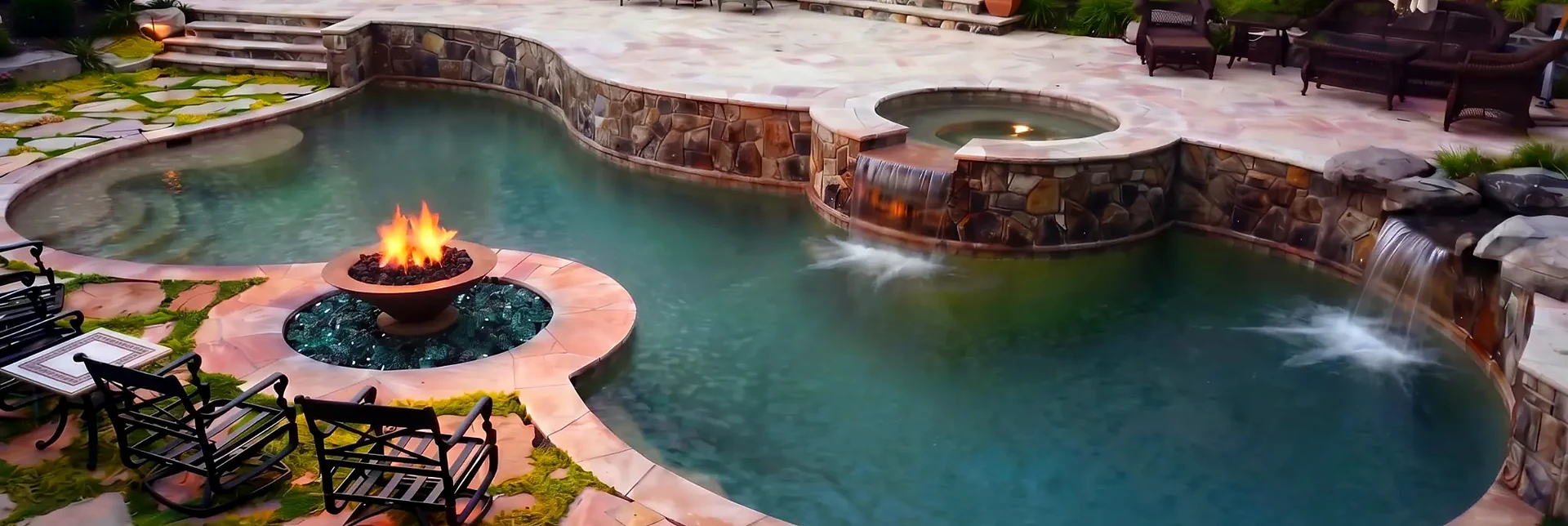
Efflorescence on pool coping is a common and visually troubling issue for owners of gunite and concrete pools in southeastern Pennsylvania and western New Jersey. The white, powdery or crystalline deposits that appear on the surface of coping can signal basic chemical migration or more complex moisture-management failures. Left unaddressed, efflorescence can undermine finishes, accelerate surface weathering through freeze-thaw action, and complicate aesthetic restoration.
This article discusses the problem candidly: what efflorescence is, why it forms on pool coping in our regional conditions, how to diagnose active versus dormant deposits, and which repair and prevention strategies are practical for different budgets and site constraints. The guidance blends chemistry, construction practice, and local climate considerations—particularly freeze-thaw cycles, clay soils, and groundwater behavior common in many Pennsylvania townships—so readers can make informed decisions about repairs, ongoing maintenance, and when to call a specialist.
- Efflorescence is salt migration driven by water carrying soluble salts out of concrete or mortar; coping shows deposits where moisture evaporates.
- In southeastern PA and western NJ, freeze-thaw cycles, clay soils, and high groundwater raise the risk; proper drainage and waterproofing mitigate it.
- Diagnosis distinguishes active moisture movement from historical deposits; cleaning without addressing moisture causes leads to recurrence.
- Repairs range from mechanical cleaning and breathable coatings to full replacement of coping and sub-drainage; costs vary widely with access, permitting, and scope.
- SPCP recommends targeted moisture control measures, seasonal inspection, and coordination with township permit rules for larger repairs.
For broader planning guidance, explore our Pool Maintenance resource center.
What Is Efflorescence and Why It Appears on Pool Coping
Efflorescence is the visible result of soluble salts migrating to a surface with evaporating moisture. In concrete and masonry, salts are present in cement, aggregates, soil, and sometimes groundwater. When water dissolves those salts, it transports them through pores and capillaries to the exposed surface. As evaporation occurs, the water leaves the salts behind as a white powder or crystalline crust.
On pool coping, efflorescence typically appears where the coping is exposed to circulating or rising moisture: near the pool waterline, at joints where backfill contacts the underside of coping, or along internal faces where groundwater or irrigation seepage interfaces with the structure. The electrochemical and capillary processes that produce efflorescence are well understood in building science, but their manifestation is heavily dependent on local conditions and construction details.
Regional Factors: Why Southeastern Pennsylvania and Western New Jersey Are Vulnerable
Local geology and climate strongly influence the likelihood and severity of efflorescence. Southeastern Pennsylvania and western New Jersey share several factors that increase risk:
- Freeze-thaw cycles: Repeated freezing and thawing of moisture-laden concrete widens cracks and opens capillaries, accelerating moisture movement and salt deposition. Winter freeze-thaw damage can also mechanically loosen deposits that then redeposit.
- Clay and mixed soils: Many local soils hold moisture and generate capillary rise. Clay can impede horizontal drainage and force water upward through the pool structure or perimeter paving.
- Shallow groundwater and perched water tables: In some valleys and low-lying areas, groundwater sits near finish grade. This increases hydrostatic pressure on the base and sides of coping and can supply dissolved salts to the concrete.
- Expansion of suburban irrigation and landscaping: Increased irrigation near patios or lawns raises near-surface moisture during the growing season, a common contributor to active efflorescence.
Because township regulations and typical lot layouts vary across Pennsylvania municipalities, solutions that alter drainage, grading, or structural elements may require review or permits. Property-specific assessment is essential.
Recognizing Signs: Differentiating Efflorescence from Other Surface Problems
Efflorescence can be mistaken for other white deposits or finish failures. Careful observation and simple tests help differentiate conditions:
- Efflorescence (salts) is powdery or crystalline and often brushes away to reveal a cleaner surface beneath. It may reappear if moisture returns.
- Leaching of lime or scale from poor-quality plaster forms a hard, adherent crust that may not brush away easily and sometimes binds with stains.
- Mold and biological growths are typically fuzzy and can be colored; they respond to biocide cleaning rather than acid-based cleaners.
- Spalling, flaking, and delamination indicate freeze-thaw damage or poor consolidation—structural symptoms that require repair beyond cleaning.
Simple field tests: a dry-bristled brush used on a small area, observation after a drying period, and a controlled wetting can reveal whether salts re-migrate. For ambiguous cases—especially when staining or structural deterioration is present—moisture measurement and lab analysis of deposits provide clarity.
Preventable Versus Unavoidable Risks in Pool Coping Efflorescence
Understanding which risks are within the owner’s control helps prioritize interventions. "Preventable" risks are those where construction detail, maintenance, or site work significantly reduces probability. "Unavoidable" risks are inherent to the site or materials and require mitigation strategies rather than elimination.
Preventable Risks
These are often related to workmanship and design:
- Poor drainage and grading near the pool perimeter—fixable with regrading, French drains, or adding permeable paving.
- Inadequate waterproofing or missing membranes between the coping and backfill—addressable at installation or during targeted retrofit repairs.
- Using low-quality or high-soluble salts-containing materials in coping or mortar—preventable through material selection and testing.
- Improper joint sealing that allows surface water to enter the assembly—solvable by replacing seals with appropriate elastomers and joint designs.
Unavoidable or Difficult-to-Eliminate Risks
These arise from natural conditions or regulatory limitations:
- High groundwater and seasonal perched water tables that cannot be fully removed without major, costly subsurface works.
- Severe freeze-thaw exposure where the local climate inherently cycles moisture and temperature—mitigation can reduce, not eliminate, impacts.
- Township constraints on exterior grading or new drains due to easements, stormwater rules, or neighbor proximity—solutions may need permitting or may be restricted.
Owners should treat "unavoidable" risks as long-term maintenance realities and budget accordingly for monitoring and future repairs, particularly where historic designs trap moisture beneath coping.
Diagnosis: How Professionals Determine Active Moisture Sources and Salt Types
Diagnosing efflorescence is a multi-step process combining visual inspection, moisture testing, and, when necessary, laboratory analysis. An accurate diagnosis guides the right repair scope—cleaning alone is rarely sufficient if moisture sources remain.
Typical diagnostic steps used by experienced pool builders or consultants include:
- Visual mapping: noting distribution, recurrence patterns, proximity to irrigation, grading low spots, and any apparent leak paths.
- Non-destructive moisture measurement: pin and pinless moisture meters used on coping, adjacent mortar joints, and substrate to identify active moisture gradients.
- Hygrometer/infrared scanning: identifying cooler, wetter areas indicative of ongoing evaporation or drainage issues.
- Salt analysis: collecting efflorescence samples for lab analysis where specific salts (sulfates, chlorides) will change repair chemistry or product selection.
- Hydrogeologic observation: during wet seasons, assessing whether groundwater or surface runoff is the source, which may include simple piezometers or probe observations in localized trenches.
When the diagnosis points to active moisture migration, we advise addressing the water pathway first—through drainage, membranes, or structural repairs—before cosmetic cleaning and sealing. Cleaning an actively migrating salt deposit can intensify visible recurrence and even lock salts into pore networks when improper sealers are used.
Cleaning and Immediate Remedies: What Works and What Risks to Avoid
When efflorescence is dormant or has been controlled by addressing moisture, surface cleaning is the next step. Common techniques differ in aggressiveness and suitability based on coping material (natural stone, precast concrete, brick, or poured concrete).
Approved cleaning approaches:
- Dry brushing: For light, powdery deposits; use soft-to-medium bristle brushes to avoid scratching stone or concrete.
- Water rinsing with detergents: A mild non-ionic detergent and low-pressure rinse remove loose salts and organic soiling.
- Mild acid cleaning: Dilute muriatic or phosphoric acid solutions can remove stubborn mineral crusts on concrete or masonry, but must be used cautiously and neutralized. This is not suitable for sensitive natural stone without specialist guidance.
- Scouring pads and mechanical agitation: Useful for textured concrete coping but avoid excessive abrasion on finished stone edges.
- Commercial efflorescence cleaners: Formulated for concrete/masonry; follow manufacturer instructions and test in an inconspicuous area.
Risks and precautions:
- Do not apply impermeable sealers before confirming that moisture is dormant; trapping salts under a film drives spalling and visible blistering.
- Muriatic acid can damage grout, adjacent plaster, and landscaping if misapplied—neutralize and rinse thoroughly.
- Power washing at high pressure can damage edges, widen microcracks, and force water into joints; use low pressure and controlled technique.
Repair Strategies by Severity and Coping Type
Repair decisions depend on the coping material and the underlying cause. Below is a practical decision framework distinguishing surface-only problems from structural moisture-management work.
Surface-only Efflorescence (No Active Moisture)
If diagnostics show no active moisture migration and the cooling/wet-dry cycle is minimal, the owner may opt for cleaning followed by breathable treatments.
- Clean with appropriate methods (dry brush, detergent, dilute acid if necessary).
- Apply breathable water-repellent silane/siloxane treatments designed for concrete and masonry. These reduce capillary water uptake while allowing trapped vapor to escape.
- Seal and replace perimeter joints with a high-quality, UV-stable elastomeric sealant after surface is dry and compatible.
Cost considerations: surface cleaning plus treatment is typically the most economical. Expect modest costs for materials and labor; natural stone cleaning often costs more than plain concrete coping.
Active Moisture but Limited Access (Retrofit Options)
When moisture is active but full replacement is prohibitive due to access, landscaping, or budget, targeted retrofits can work:
- Install perimeter French drains or sub-surface drains where access permits—this reduces water contact behind the coping.
- Add or repair flexible flashing and membranes above or behind the coping where feasible (requires careful detailing to avoid harming finishes).
- Improve grading and add guttering or downspout extensions to divert surface runoff away from the coping perimeter.
These solutions reduce hydrostatic pressure and capillary rise but may be less effective where groundwater is consistently high; long-term monitoring is recommended.
Extensive Damage or High Groundwater (Major Reconstruction)
When efflorescence is symptomatic of high groundwater, continuous seepage, or freeze-thaw damage with spalling and loss of structural integrity, more invasive measures are required:
- Full removal and replacement of coping with improved detail: reinforced concrete or natural stone installed over a waterproof membrane and proper weep/drain systems.
- Excavation to install a comprehensive perimeter drainage system connected to an approved discharge point or sump system per local codes.
- Reconstruction of adjacent paving and grade to ensure positive slope away from pool; where municipal regulations require, obtain permits for stormwater handling.
These repairs carry significantly higher costs due to demolition, excavation, possible traffic control, and township permit fees. Local permit requirements in many Pennsylvania townships can affect timeline and scope.
Cost Implications: Typical Ranges and Influencing Factors
Costs for diagnosing and repairing coping efflorescence vary widely. Below is a general guide; local site conditions and contractor pricing cause variance. Always obtain itemized estimates and confirm whether a contractor includes diagnostic testing, materials, and permitting in the quote.
| Work Type | Typical Cost Range (USD) | Key Cost Drivers |
|---|---|---|
| Basic inspection and moisture testing | $300–$1,000 | Number of test points, lab samples, travel |
| Surface cleaning and breathable treatment | $500–$3,000 | Coping length, material type, access, acid use |
| Targeted drainage retrofit (French drain, grading) | $1,500–$8,000 | Excavation depth, length, conduit routing, discharge point |
| Partial coping replacement (limited sections) | $3,000–$12,000 | Material (stone vs. precast), edge details, finishing |
| Full coping replacement + waterproofing + drainage | $10,000–$50,000+ | Extent of demolition, excavation, landscaping, permits |
In Pennsylvania, expected permit costs and review times should be factored in for any work that disturbs grading, utilities, or greater-than-threshold excavation. Contractor mobilization, seasonal demand (spring and early summer busiest), and weather delays in fall and winter also influence final costs.
When to Hire an Expert: Scope and Timing Considerations
Not every efflorescence case needs a full-fledged specialist, but the following conditions suggest hiring a qualified pool contractor or building envelope specialist experienced with local conditions and township practices:
- Recurrent or rapidly reappearing efflorescence after cleaning—indicates active moisture migration.
- Evidence of structural distress: spalling, delamination, cracks running through coping or bond beam.
- High groundwater or visible seepage at the coping-substrate interface.
- Complex access or landscape constraints that make replacement or drainage retrofits nontrivial.
- When work may require permits, modifications to stormwater routing, or changes to grading that could trigger township review.
SPCP process: We perform a staged evaluation—visual mapping, targeted moisture testing, and salt sampling if required—then prepare an options report with costed recommendations, maintenance consequences, and permit considerations. We recommend addressing moisture sources first; any cosmetic work follows a documented drying and mitigation period.
Preventive Maintenance and Long-Term Management
Long-term control of efflorescence emphasizes moisture management, routine inspection, and appropriate material choices. Preventive measures are relatively low-cost compared with reconstruction and help extend coping life in freeze-thaw climates.
- Seasonal inspections: Check coping, joint sealants, and surrounding grades in spring and fall after snowmelt and heavy rains. Replace degraded sealants proactively.
- Maintain perimeter drainage: Keep gutters, leaders, and any surface drains clean and functioning. Clear plantings that trap moisture against coping edges.
- Use breathable water repellents where appropriate: For dormant problem areas, silane/siloxane treatments reduce water uptake while permitting vapor transmission.
- Monitor irrigation: Reorient sprinklers and lower run times near coping to reduce surface saturation.
- Document repairs and observations: Records help technicians correlate repairs with recurrence and guide future work.
SPCP recommendation: For new construction, specify coping details that integrate a waterproof membrane, proper fall, and accessible drainage. For renovations, prioritize limited but effective drainage upgrades to deflect groundwater and surface flow away from the coping.
Material Selection and Installation Best Practices for New Coping
Selecting the right materials and detailing them correctly at installation reduces future efflorescence risk. For new builds in southeastern Pennsylvania and western New Jersey, consider the following best practices:
- Specify low-soluble cement mixes and well-graded aggregates. Use reputable precast coping systems or properly cured poured concrete with additives that reduce water absorption.
- Install continuous waterproofing membrane under and behind coping where it abuts the pool edge. Membranes should be compatible with the chosen coping adhesive and joint sealants.
- Provide positive surface drainage on coping with a slight slope away from the pool and ensure surrounding paving also slopes away to prevent ponding.
- Include a subsurface drain or weep system where groundwater is known to be high; connect to an approved discharge point per township rules.
- Use compatible, high-quality joint sealants and follow manufacturer open-time and cure guidance; avoid packing joints with cementitious slurries that wick moisture.
Installation quality is as important as material choice. Even premium stone coping will suffer if membranes are torn, joints are poorly sealed, or adjacent grading channels water back to the pool edge.
Seasonal Timing and Township Considerations for Repairs in Pennsylvania
Seasonality affects both the feasibility and effectiveness of repairs. In Pennsylvania, winter freeze-thaw cycles limit when exterior masonry and concrete repairs should be performed. Township permit cycles and weather windows also matter.
- Best repair window: late spring through early fall when temperatures are reliably above freezing and materials can cure properly. Concrete and sealant manufacturers often specify minimum temperatures for installation.
- Off-season observations: early spring often shows the worst signs because of winter moisture and frost heave; use that window for diagnosis, then plan repairs for warmer months.
- Permits and inspections: many townships require permits for excavation, drainage changes, and major masonry replacements. Allow additional lead time for plan review and possible stormwater approvals.
- Access and traffic: Some neighborhoods have restrictions on heavy equipment, driveway disruption, or noise; coordinate timelines with township regulations and homeowner association rules, if applicable.
Careful scheduling reduces rework and ensures materials cure in recommended conditions—critical for sealants and concrete overlays designed to resist future moisture migration.
Case Studies and Examples (Representative Scenarios)
Below are brief representative scenarios illustrating diagnosis and chosen remediation paths. These examples are fictional but reflect typical outcomes in the region.
Case A: Shallow groundwater, recurring salts
Symptoms: Persistent efflorescence on the pool’s northside coping, reappearing after cleaning. Moisture meters indicated active wetness behind coping. The property sits in a shallow valley with a seasonally high water table.
Response: A perimeter French drain tied to an existing storm line was installed, coping joints were resealed, and a breathable water-repellent was applied after a drying period. Monitoring continued for two summers; recurrence ceased.
Case B: Irrigation overspray and isolated deposits
Symptoms: Localized deposits near the lawn edge where a spray head oversprayed onto the patio. No structural damage.
Response: The owner reoriented irrigation heads and reduced run-time. The deposits responded to detergent cleaning and brushing; a maintenance program prevented recurrence.
Case C: Freeze-thaw damage with spalling
Symptoms: Large areas of spalling and flaking on coping edges after multiple winters. Salt crusts were present and bonding was compromised.
Response: Coping was removed and replaced with new precast units over a waterproof membrane. A drain was installed and grade adjusted. The project required a township permit and was scheduled for summer construction.
Choosing a Contractor and What to Ask
Selecting a contractor with local experience is critical. Candidates should demonstrate knowledge of regional soil and climatic issues, township permitting, and both cosmetic and structural remediation techniques.
Key questions to ask prospective contractors:
- Do you perform moisture diagnostics and do you include that in the estimate?
- Can you provide references for coping repairs in southeastern Pennsylvania or western New Jersey?
- Will the proposed repairs require township permits, and will you handle permit procurement and inspections?
- What warranty is offered on workmanship, and how does it interact with material warranties?
- How will site drainage and grading be verified and documented before and after the work?
Ask for a written, itemized scope of work that separates diagnostic costs, materials, permits, labor, and contingency. SPCP suggests obtaining two or three competitive estimates and verifying insurance and local licensing before hiring.
Body CTA
If you are seeing efflorescence on your pool coping or want an assessment tailored to your lot in southeastern Pennsylvania or western New Jersey, consider scheduling a professional evaluation. We can provide a staged diagnostic report and recommend costed options that reflect township requirements and seasonal timing. Begin the process and start your pool journey with a site-specific plan.
Keep Reading — Build Your Knowledge
- Choose the Best Winter Pool Cover with Confidence
- Saltwater Swimming Pool Maintenance Costs: What PA Owners Pay Each Year
- Get Your Pennsylvania Pool Ready for Winter Weather
- Spend More Time Swimming, Less on Maintenance
- Dial In the Perfect Pool Water Temperature Year-Round
- Browse All Pool Maintenance Articles →