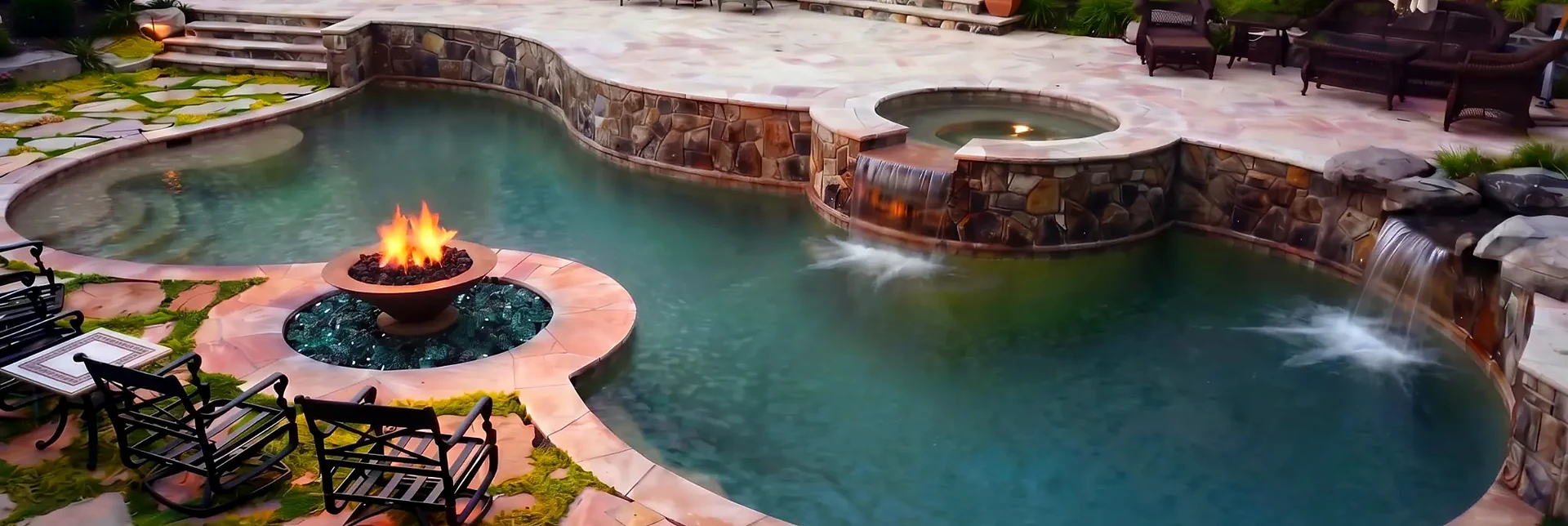
Choosing between a tanning ledge (sometimes called a sun shelf or Baja shelf) and a beach entry (also called zero-entry) pool is a common decision for homeowners planning a custom gunite pool in southeastern Pennsylvania or western New Jersey. Both design types provide shallow lounging space and an elegant transition between landscape and water, but they perform differently on circulation, safety, winterization, construction complexity, and long-term cost—factors that matter in climates with freeze-thaw cycles, variable soils, and municipal permitting nuances.
This article compares tanning ledges and beach entries across a series of practical criteria to help homeowners, contractors, and landscape professionals make informed choices. The comparison addresses usability, accessibility, aesthetics, construction and site constraints, maintenance and lifecycle costs, safety, and specific regional considerations—such as clay soils, groundwater, township permitting, and seasonal construction windows in Pennsylvania and New Jersey.
- Tanning ledges are compact, cost-effective shallow platforms ideal for small yards and added water features; beach entries provide a gradual shore-like slope better for multi-generational access and integrated landscaping.
- Tanning ledges generally cost less to build and heat but can complicate circulation and winter drainage in freeze-prone areas; beach entries require more excavation and water management but distribute freeze stresses more gradually.
- For properties with high groundwater, shallow bedrock, or limited access, tanning ledges typically reduce excavation risk; properties with gentle grade and ample space are better candidates for beach entries.
- Maintenance differs: tanning ledges collect debris and require skimming/cleaning and careful balancing; beach entries need erosion control, edging details, and attention to filter skimming zones—both need winterization but with different focus areas.
- Select design based on user profiles: active loungers and small-yard owners often prefer tanning ledges; families with small children, elderly users, or pool-driven landscaping prefer beach entries.
For broader planning guidance, explore our Pool Decisions resource center.
Understanding the Basics: What Each Design Is and How It Works
A tanning ledge is a flat, typically 6–18 inches deep shelf built into the pool perimeter. It’s intentionally shallow to accommodate chaise lounges, umbrella stands, or child play while allowing deeper swimming areas just steps away. A tanning ledge may be standalone or part of a layered shallow zone with steps, bubblers, or integrated spas.
A beach entry is a gradual sloping entry that mimics a natural shoreline: a zero-depth or near-zero-depth transition that slopes down over several feet into the pool’s swimming depth. Beach entries often include planting pockets, decorative edging, and permeable transition zones. They can be subtle or dramatic depending on the slope, width, and blending with hardscape.
Criterion-by-Criterion Comparison
The following table summarizes practical tradeoffs for each major decision criterion. It is designed to help homeowners weigh priorities rather than prescribe a single best choice.
| Criterion | Tanning Ledge | Beach Entry |
|---|---|---|
| Space required | Compact; suitable for small to medium yards; can be integrated across part of a pool perimeter. | Requires more horizontal run; better for larger yards or where shallow transition is a central landscape feature. |
| Construction complexity | Moderate; standard gunite formwork for a shelf; localized reinforcement and coping details. | Higher; larger excavation, gradual slope shaping, and more extensive sub-base work and drainage. |
| Access & accessibility | Provides a shallow lounging platform but not full mobility access; can be paired with handrails or steps. | Excellent for gradual access: stroller- or wheelchair-friendly with additional elements; better for kids and seniors. |
| Circulation & water quality | Can create dead zones if not plumbed correctly; skimmers may be less effective over a broad shelf. | Improves circulation if designed with proper drains and skimming lines; surface area increases evaporation and can affect chemistry. |
| Safety | Clear depth delineation; risk of slipping when wet; can be designed with non-slip finishes. | Gentle slope reduces abrupt depth changes but may trick perception of depth; landscaping edges must prevent trip hazards. |
| Freeze-thaw & PA climate | Requires careful winter drainage of shelf and lines; localized ice expansion can stress finishes. | Slope and larger shallow area change freeze dynamics; drainage and dewatering plans must accommodate freeze cycles and groundwater. |
| Cost | Typically lower initial cost and lower heating energy for the small surface area. | Higher initial cost due to excavation and materials; potentially higher heating and maintenance costs depending on surface area. |
| Landscape integration | Works well with compact hardscape; good for pool furniture staging and water features. | Better integrated with naturalistic landscapes, planting pockets, and gradual transitions to patios or lawn. |
Construction and Site Constraints in Southeastern Pennsylvania & Western New Jersey
Gunite pool construction in this region intersects with specific geotechnical and permitting realities. Soils can range from heavy clays that hold water and expand during freeze-thaw cycles to shallow bedrock on ridge tops and high groundwater in river valleys. These conditions influence whether a tanning ledge or beach entry is more practical.
For sites with clay soils and high seasonal groundwater, a tanning ledge reduces excavation depth and concentrated cut volumes, which can keep subgrade disturbance lower and reduce need for dewatering. Conversely, a beach entry often requires broad, shallow excavation that can interact with perched water tables and necessitate subdrain systems or underdrain conduits to prevent hydrostatic pressure beneath the slope.
Township permitting in Pennsylvania and New Jersey often requests grading plans, erosion and sedimentation controls, and details for stormwater drainage. A beach entry may trigger additional plan review because of its increased footprint and potential to alter surface runoff patterns. Contractors should factor in local municipal review timelines and season-specific restrictions (for example, tree protection periods or limits on heavy equipment on saturated soils).
Access, Equipment, and Seasonal Windows
Access for heavy equipment plays a key role. If the property has narrow driveways, mature trees, or restrictive easements, the smaller excavation volumes for a tanning ledge can be advantageous. Beach entries require more lateral access and staging area for spoils, making them more suitable where machinery can move freely around the pool perimeter.
Seasonality matters: in Pennsylvania and New Jersey, spring thaws and late-autumn freezes affect when heavy excavation is feasible. Contractors often prefer to complete significant grading in late spring through early autumn when soils are drier. Homeowners who want a beach entry should expect longer construction windows and potential schedule constraints tied to municipal inspections and wet-season limitations.
User Experience: Accessibility, Play, and Aesthetics
How a family will use the pool often determines which option feels “better.” Tanning ledges are excellent for sunbathing, placing loungers partly submerged, or creating a shallow play area for toddlers under close supervision. They also become staging points for umbrellas, side tables, and poolside features like bubblers and small jets.
Beach entries shine when the goal is seamless integration with lawn or patio; people can walk slowly into the water, which is ideal for children, seniors, and adaptive uses. The gradual slope resembles a natural shoreline and can be turned into a focal point with plantings, boulder features, or low retaining walls. Beach entries enhance the visual flow from landscape to water and can create a resort-like aesthetic.
Family Profiles and Use Cases
Consider these simplified homeowner profiles:
- Small-yard urban family who entertains poolside and wants integrated loungers: tanning ledge fits well because of compactness and lower cost.
- Multi-generational household with small children and mobility needs: beach entry provides safer, progressive access and play space.
- Owners aiming for dramatic landscape integration and pool-as-centerpiece: beach entry affords greater design freedom and planting opportunities.
- Renovation on a constrained lot with drainage or high bedrock: tanning ledge often reduces excavation impact and project risk.
Hydraulics, Circulation, and Water Quality Considerations
Hydraulics affect how well the pool keeps clear, how easy it is to heat, and how chemicals behave. Tanning ledges increase surface area concentration in a defined zone—in some designs this can create “dead water” where skimming is less effective unless return, suction, and skimmer placement are carefully balanced. Pumps and returns should be planned to direct flow across the ledge and toward skimmers.
Beach entries increase overall shallow surface area, which can enhance evaporation and heat loss, potentially increasing heater runtime in shoulder seasons. Because of the long shallow slope, beach entries can benefit from perimeter drains, linear skimmers, or surface-sweeping returns to maintain water movement and prevent algae-prone quiet areas.
Equipment and Design Solutions
Design strategies that improve circulation for each type include:
- Tanning ledge: place a directional return aimed along the ledge, add a dedicated suction line for automatic cleaners, and consider a dedicated floor or ledge drain if the ledge is large.
- Beach entry: incorporate multiple skimmers or a long skimmer to service the shallow plane, include subdrains behind planting pockets, and slope the sub-base to prevent standing water under finishes.
- Both designs: use variable-speed pumps and flow-control valves to balance turnover and reduce noise; include automated chemical feeders and UV or ozone systems for added water-quality resilience.
Maintenance, Winterization, and Lifecycle Costs
Maintenance tasks differ meaningfully. Tanning ledges require frequent skimming of debris that falls onto the shelf and periodic brushing of the shallow plane’s finish. Small items (toys, leaves) accumulate more visibly on a ledge. Beach entries, because of their larger edge, can allow some wind-deposited material to settle along the slope and in planting pockets, which requires routine vacuuming or manual removal.
Winterization is especially important in Pennsylvania and New Jersey. Freeze-thaw cycles can cause pressure against pockets of trapped water. For tanning ledges, it’s essential to ensure any deck jets, bubblers, or small returns on or near the ledge are properly winterized or isolated and that the ledge surface is drained when possible. For beach entries, attention should focus on edge drainage and any landscaping features that can trap meltwater; subdrain systems or French drains may be necessary to route groundwater away from the pool shell during freeze-thaw cycles.
Lifecycle Cost Considerations
While exact costs depend on finishes, equipment, and site conditions, the following generalities apply:
- Initial construction: tanning ledges are usually less expensive because they require less excavation and fewer landscape alterations. Beach entries increase excavation and require more shaping, increasing labor and disposal costs.
- Operating costs: beach entries may increase heating and water loss due to larger shallow surface area; tanning ledges concentrate shallow water in one zone, often cheaper to cover or heat locally.
- Maintenance costs: both require routine care; beach entries may need more attention to edge landscaping and potential erosion control, while tanning ledges may require more frequent surface cleaning.
- Repair and resurfacing: both are gunite finishes subject to the same lifecycle for plaster or aggregate finishes; however, beach entries with complex planting edges or integrated stonework can raise future repair costs for edgework.
Homeowners should budget for regular maintenance, periodic replastering or refinishing every 10–20 years (depending on finish), equipment replacement every 7–15 years, and potential remedial work to address drainage or hydrostatic issues in problematic soils.
Safety, Codes, and Warranty Considerations
Pool safety is shaped by design as much as by barriers and behavior. Tanning ledges create a defined shallow platform where children can congregate; this facilitates supervision but also creates a temptation to run or jump from the ledge into deeper water. Non-slip finishes, clear depth markers, and unobstructed sightlines are recommended.
Beach entries reduce sudden depth transitions, which can be safer for novice swimmers and small children, but they also require thoughtful edging and plant placement to avoid concealed trip hazards where lawn transitions into water. Both designs should be integrated with code-compliant barriers, alarms, and compliant pools covers where required by township or state regulations. Pennsylvania municipalities may have specific barrier setbacks and fencing rules; always confirm local code and permit requirements during the design phase.
Warranties on structural gunite vary by contractor; equipment typically carries manufacturer warranties. Avoid promises of lifetime performance; instead, request written warranty terms for the shell, equipment, and finishes. Documented maintenance schedules are often conditions for honoring certain equipment warranties.
Pennsylvania-Specific Construction and Permit Notes
In southeastern Pennsylvania, township regulations can vary significantly. Some townships require engineered drawings for any pool over a certain volume, while others require erosion control and stormwater management plans if the pool alters drainage across the lot. Western New Jersey municipalities similarly vary, with certain jurisdictions enforcing additional setbacks from wetlands or regulated streams.
Key local considerations include:
- Freeze-thaw mitigation: design drainage so that water does not pond against the shell. Consider installing subdrains to capture groundwater and route it to approved discharge points.
- Soil variability: request a geotechnical review for sites with known clay, shale, or shallow bedrock to evaluate excavation methods and backfill compaction specifications.
- Access and road permits: if heavy equipment must drive over a public right-of-way, some municipalities require permits and deposit for restoration.
- Seasonal constraints: deep excavation and extended grading are best scheduled outside of winter and peak spring runoff; discuss realistic timelines with the contractor to avoid mid-winter delays.
Design Tradeoffs: When One Is a Better Fit Than the Other
No universal winner exists; design choice aligns to homeowner goals and site realities. Below are tradeoffs and recommended fits:
Why choose a tanning ledge?
- Limited yard area or narrow pool envelope.
- Budget-conscious projects seeking a high-impact feature without broad excavation.
- Properties with high groundwater or shallow bedrock where minimizing excavation depth matters.
- Homeowners who prioritize sun-lounging and pool furniture staging.
Why choose a beach entry?
- Desire for inclusive, gradual access for children, seniors, or mobility-challenged users.
- Large enough yard to accommodate the slope without crowding other landscape elements.
- Projects emphasizing landscape integration and naturalistic aesthetics.
- Sites where the horizontal footprint doesn’t trigger problematic grading or runoff constraints.
Poor-Fit Scenarios
Scenarios that make tanning ledges a poor fit include households needing universal access (ramp or gentle slope preferred) or sites where ice and freezing will pond on a flat shelf in winter. Beach entries can be poor fits on tiny lots, where property lines restrict the required run, or in steeply sloped backyards where achieving a gradual slope would demand retaining walls or excessive fill.
Decision Checklist and Next Steps
Use this checklist during initial planning and site assessment. It helps clarify practical tradeoffs and ensure the chosen design aligns with property constraints and homeowner goals.
- Assess yard dimensions and available horizontal space for a beach entry slope versus ledge integration.
- Order or review a basic soil report if the site is known for clay, shale, or shallow rock.
- Confirm local township permit requirements for grading, stormwater, and barrier fencing.
- Evaluate access for heavy equipment—measure gate widths and driveway load limits.
- Decide on primary user groups (kids, seniors, entertainers) and prioritize accessibility features.
- Ask your contractor for plumbing and circulation plans specific to the chosen design, including skimmer placement, returns, and subdrain needs.
- Budget for winterization measures specific to the design and local freeze-thaw exposure.
Scott Payne Custom Pools recommends site-specific review and offers on-site consultations to align pool design with a property’s soils, drainage, and municipal requirements. We can produce a layout that balances aesthetics, hydraulics, and long-term upkeep with your lifestyle goals.
Ready to take the next step? Begin with a conversation and site visit to outline options, budget ranges, and permitting pathways—visit start your pool journey to schedule an initial consultation.
Body CTA
If you’re weighing a tanning ledge versus a beach entry for a custom gunite pool in southeastern Pennsylvania or western New Jersey, start with a free site assessment and conceptual plan. We’ll evaluate access, soils, drainage, and permit requirements and provide comparative design sketches to visualize tradeoffs. Click here to start your pool journey and schedule an on-site consultation with a Scott Payne Custom Pools designer.
Keep Reading — Build Your Knowledge
- LUXURY POOL DESIGN IN TRAINER, PA — CUSTOM INGROUND POOLS
- LUXURY POOL DESIGN IN GLADWYNE, PA — CUSTOM INGROUND POOLS
- LUXURY POOL DESIGN IN WALLACE, PA — CUSTOM INGROUND POOLS
- Heat Pump vs Gas Pool Heater: Costs, Efficiency, and Best Uses in PA
- LUXURY POOL DESIGN IN MONTGOMERYVILLE, PA — CUSTOM INGROUND POOLS
- Browse All Pool Decisions Articles →